Fifty Folding Chairs and a Lot of Trust: Inside Waterstown's House-Show Boom
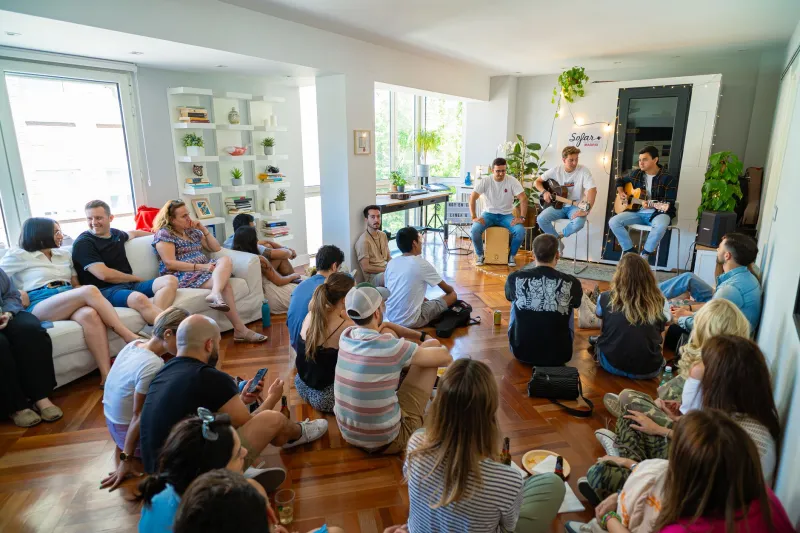
There's a house on the north end of Waterstown where the front door opens into a hallway, the hallway opens into a living room, and that living room holds about forty people on a good night — in folding chairs borrowed from three different neighbors, with a card table by the stairs doing double duty as a merch stand.
Nobody's getting rich off it. That's sort of the point.
House concerts have existed in this country for a long time — the living-room folk circuit, the back-porch bluegrass nights, the whole tradition of somebody deciding their square footage is wasted on a television. But in Waterstown, they've quietly stopped being a quirky side note. Ask around the scene and you'll hear the same thing from hosts, players, and the people who show up with a six-pack and a folding chair: the house-show calendar has become one of the most dependable live-music experiences in town.
When the room itself is the venue
A house show doesn't have a sound engineer in a booth, a bar to shout over, or a lighting rig that can turn a mediocre set into a tolerable one. What it has is proximity, and proximity does most of the work.
You can hear a guitar string buzz. You can hear the singer take a breath before the second verse. When someone in the back row laughs at a line between songs, the performer hears it and answers back, and suddenly the whole thing is a conversation instead of a broadcast. There's no fourth wall to speak of, which means there's nowhere for either side to hide.
That's a high-wire act for a performer. It's also the reason a lot of them love it. A room of forty people who are actually listening will tell you the truth about a song faster than a crowd of four hundred who are three drinks in.
The host is the curator, and the curation is the whole game
Here's what surprised me most when I started poking at how these nights get put together: the hosts are not passive. They're not just people with a big enough living room and a permissive spouse.
The good hosts in Waterstown treat a lineup like a dinner party seating chart. They think about who will enjoy whom. They pair a songwriter with a cellist because the two will trade stories between sets. They'll slot a nervous first-timer into the opening thirty minutes, when the room is still settling in and the stakes feel low. They know which of their regulars will show up early to help carry chairs and which ones will quietly leave a twenty in the jar on the way out.
And they vet their guests, too. Not in a snobby way — in a practical one. A house show lives and dies on the behavior of the room. If people talk through the set, the format collapses. So hosts build a list the way you'd build a guest list for anything else you care about: carefully, and over time.
That's why the invite is often the whole story. Half the people in those chairs got there because somebody trusted them enough to send a text.
Why touring artists keep asking for the porch
Talk to players who pass through Waterstown and you'll hear a familiar refrain: the stop gets requested. Not because it pays the best — it usually doesn't — and not because it's convenient. It gets requested because a good house show produces something a mid-size club can't.
A few reasons come up again and again.
- The audience is there on purpose. Nobody wandered in from the street. Nobody's waiting for a DJ. They came for the songs.
- The merch table actually works. Forty people who just spent ninety minutes silently listening to you tend to buy something on the way out. It's not a fortune, but it's real, and it's immediate.
- It's a reset night. Players talk about the living-room stop as the night that reminds them why they're doing any of this at all — after a month of load-ins, bad monitors, and crowds shouting over the chorus.
There's also the practical stuff. A house show means no stage plot, no advance email chain, no promoter who forgot to promote. You show up, you set up near the fireplace, you play, somebody hands you a plate of something warm.
The economics of a pass-the-hat night
Let's be honest about the money, because the money is what makes this fragile and what makes it work.
Most of these nights run on a suggested donation at the door, plus whatever the hat brings in, plus merch. The host covers the food and the coffee. Nobody's taking a cut. That means the artist walks away with a meaningful chunk of a small number — which is often better than a small chunk of a big number after expenses.
It also means the risk is spread around in a way that feels human. If twenty people show up instead of forty, nobody loses their shirt. If sixty show up, everyone's delighted and the host starts wondering where they can borrow more chairs.
The tradeoff is scale. You can't do a house show for a hundred and fifty people without it becoming something else entirely. So the circuit stays small by design — and the people running it seem perfectly happy with that.
What the boom actually tells us
Waterstown has spent years building a live-music reputation that punches well above its population. The house-show scene is the most intimate layer of that — smaller than the venues, less visible than the festival calendar, and arguably more influential than either.
Because here's the thing: house shows are where the audience learns how to listen. And an audience that knows how to listen is the single most valuable asset any music town can have. It changes how people behave at the clubs. It changes what artists get out of a Tuesday night in a small town. It creates the kind of reputation that travels by word of mouth instead of a marketing budget.
So if you get an invite this winter, take it seriously. Bring something to share, show up on time, put your phone away, and stay for the last song. You're not just seeing a show. You're holding up one end of the room.